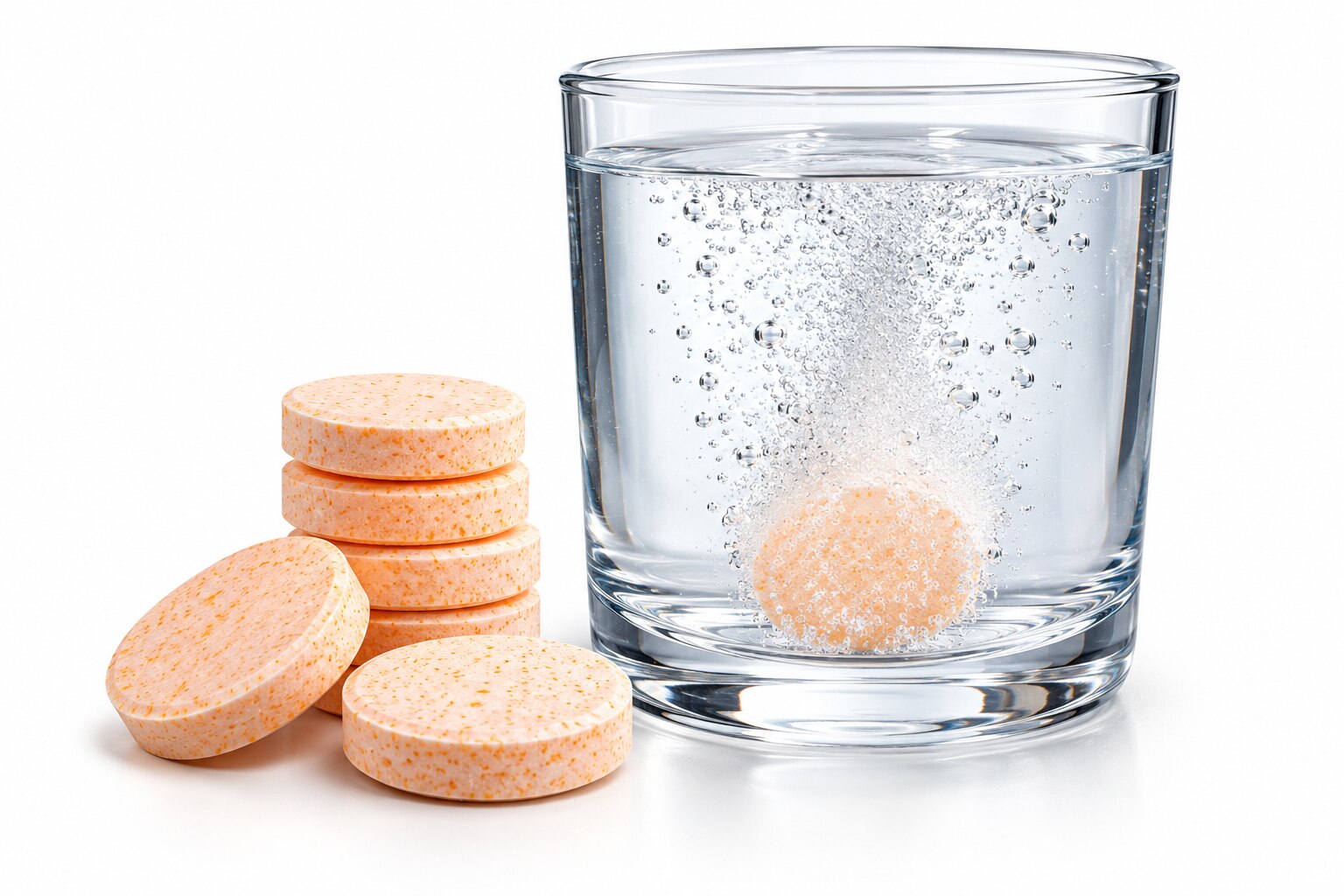
An effervescent tablet must dissolve completely in a measured volume of water, release carbon dioxide at a controlled rate, and remain dry until use. By the end, you will know how to assess the formulation, manufacturing controls, test evidence, packaging, and regulatory records behind a reliable production partner.
Key takeaways
- Balance acid and bicarbonate quantities for complete, controlled dissolution.
- Protect powder and tablets from humidity during manufacturing and packing.
- Request disintegration, dissolution, moisture and stability data before approval.
- Compare proposed packs by moisture barrier, seal integrity and handling requirements.
What an Effervescent Tablet Contains and How It Works
An effervescent tablet is designed to dissolve in water before you drink it; a conventional oral tablet is swallowed whole and breaks down in the gastrointestinal tract. Its acid–bicarbonate system combines an acid, such as citric or tartaric acid, with sodium bicarbonate or another carbonate.
In water, the acid–carbonate reaction drives carbon dioxide release, dispersing the active pharmaceutical ingredient in a drinkable solution or suspension. Moisture can trigger this reaction during manufacture, soften tablets, and reduce gas before use.
The ingredients that control performance are:
- Active pharmaceutical ingredient: dose, solubility, taste and pH stability determine whether effervescent delivery is suitable.
- Acid: citric, tartaric or malic acid sets acidity, taste, hygroscopicity and reaction speed.
- Carbonate or bicarbonate: sodium bicarbonate supplies the alkaline reactant; 1 g contributes about 274 mg of sodium.
- Sweetener and flavour: these mask acidity and improve acceptance without slowing dissolution.
- Binder and flow aid: these support granulation, powder movement and tablet strength.
- Lubricant: its level affects compression, wetting and how quickly the tablet reacts.
| Feature | Effervescent tablet | Conventional oral tablet |
|---|---|---|
| Use | Dissolve in water first | Swallow directly |
| Main performance event | Gas release and rapid dispersion | Disintegration after swallowing |
| Key vulnerability | Moisture uptake before use | Usually less moisture-sensitive |
| Critical balance | Reaction speed, hardness and taste | Strength, disintegration and dissolution |
How to Match the Formulation to the Active Ingredient
An active pharmaceutical ingredient is suitable for an effervescent tablet only when its dose, solubility, taste, pH stability and moisture sensitivity fit an acid–bicarbonate system. Check compatibility with acids and alkaline salts before choosing excipients; a conventional immediate-release tablet formula is not automatically transferable.
Use these development checks:
- Confirm that the intended dose dissolves in the prescribed water volume without excessive sediment or an impractical tablet size.
- Measure stability across the finished solution’s target pH, then test the active pharmaceutical ingredient against each acid and sodium bicarbonate.
- Assess hygroscopicity, because moisture uptake can trigger reaction before use and cause swelling, softening or lost effervescence.
- Set the acid-to-base ratio, particle-size distribution, lubricant level and compression force together; changing one can alter reaction speed, hardness, mouthfeel and dissolution.
- Calculate sodium from every source. Sodium bicarbonate is about 27.4% sodium by mass, so 1 g contributes roughly 274 mg before other sodium-containing ingredients are added.
| Acid system | Formulation implication | Selection point |
|---|---|---|
| Citric acid | Strong acidity and a bright, sharp taste | Use only after checking hygroscopicity and active compatibility |
| Tartaric acid | Different salt-forming behaviour and sharper sensory profile | Compare granule stability and dissolution, not cost alone |
| Malic acid | Distinct acidity and smoother sourness | Confirm reaction rate and storage stability |
Add a sweetener and flavour to control bitterness, a lubricant at the lowest effective level, a binder for tablet strength, and a flow aid for uniform die filling. Lock the acid system during development; late substitution can change stability and patient acceptance.
Moisture Control from Dispensing Through Packing
One humid transfer can start the acid–bicarbonate reaction before the tablet reaches water. Moisture uptake causes swelling, softening, weight variation and loss of effervescence; it can also turn a sound blend into a sticking or capping problem during compression.
Protect the process with controls that follow the material, not just the room:
- Dispense acids, bicarbonate, active ingredient and excipients in a controlled relative humidity (RH) area, with calibrated temperature and RH records.
- Keep containers closed between weighing, blending, compression and packing; define maximum bulk hold times.
- Set blend and dry-processing endpoints using water content and flow results, then check for segregation after transfer.
- Control compression force and turret speed. Excess force can worsen capping, while insufficient force produces low hardness and high friability.
- Inspect punches and dies for powder build-up; sticking can damage faces and create dose or appearance defects.
- Monitor room RH, blend exposure time, tablet weight, hardness, friability and effervescence performance during validation and routine production.
- Seal tablets promptly in a moisture-barrier tube with desiccant or a high-barrier foil blister, then test seal integrity and moisture ingress.
| Risk | What goes wrong | Control to verify |
|---|---|---|
| Humidity exposure | Premature reaction and reduced gas release | RH mapping, closed transfers and water-content checks |
| Compression variation | Capping, sticking, weak hardness or excessive friability | Force, speed, weight and mechanical-strength trending |
| Pack failure | Gradual moisture uptake during storage | Leak testing and in-use stability in the proposed pack |
A generic “well packed” claim is not evidence. Request stability data covering water content, carbon-dioxide release, dissolution or disintegration, hardness, friability and pack integrity across the proposed shelf life.
Tests That Prove Effervescence and Product Quality
Request the complete test report, not only a certificate of analysis. It should show results against approved specifications, test methods, batch numbers, and analyst approval. A passing assay does not prove that the tablet releases carbon dioxide, dissolves fully, or remains usable after storage.
| Test | What the result proves | What it does not prove |
|---|---|---|
| Effervescence time | The tablet completes its acid–bicarbonate reaction within the specified time in water | It does not confirm active-ingredient release |
| Disintegration | The tablet breaks apart; the European Pharmacopoeia benchmark is within 5 minutes unless a monograph says otherwise | It does not replace dissolution testing |
| Dissolution | A defined percentage of the active ingredient enters a specified medium within a set time | It does not measure the speed of gas release |
| Assay | The total active-ingredient strength in the tested sample | It does not show that each tablet contains the same amount |
| Content uniformity | Individual dosage units contain consistent active-ingredient amounts | It does not demonstrate shelf-life performance |
| Stability data | Performance remains acceptable through storage, including water content, pH, hardness, friability, carbon-dioxide release, and pack integrity | Initial release results alone cannot support the proposed shelf life |
- Also request average weight, weight variation, hardness, friability, pH, and microbial quality results where applicable.
- Ask for method-validation evidence covering specificity, accuracy, precision, range, response, and robustness for assay, content uniformity, dissolution, related substances, and water content.
- Review real-time and accelerated stability data in the proposed tube or foil blister, including moisture ingress and repeated-opening performance.
How to Evaluate a Contract Manufacturer and Proposed Pack
Do not approve a commercial batch on a sample and a general claim of GMP compliance. Ask for documents that connect the exact effervescent formulation, strength, dosage form and proposed pack to an authorised manufacturing process.
1. Verify the current manufacturing licence issued by the Delhi State Licensing Authority, product permissions, and applicable CDSCO requirements. Confirm that the documents cover the specific dosage form, active ingredient, strength and brand; a general tablet licence does not prove authorisation for your product.
2. Review recent batch records, certificates of analysis, validated test methods and process qualification data. Check controls for room humidity, moisture exposure, compression, blend uniformity and cleaning between products.
3. Treat the pack as part of the formulation. For a moisture-barrier tube, request desiccant specification, closure performance and moisture-ingress data. For a high-barrier foil blister, request seal-integrity and barrier data. Require in-use stability results that simulate repeated opening or removal of tablets, not only unopened packs.
4. Read stability reports through the proposed shelf life. Look for water content, acid–base reaction performance, dissolution or disintegration, hardness, friability, carbon-dioxide release, microbial quality where applicable, and pack integrity. Check the label calculation too: 1 g of sodium bicarbonate contributes about 274 mg of sodium before other sources are counted.
Use the same evidence request with Monique Pharmaceuticals Pvt Ltd, rather than accepting a capability statement in place of product-specific records. Reject the proposal if the manufacturer cannot show traceable data for the chosen pack and commercial process.
Frequently asked questions
What does an effervescent tablet contain?
It contains an acid, such as citric or tartaric acid, paired with sodium bicarbonate or another carbonate. Water triggers the reaction that releases carbon dioxide and dissolves the tablet.
How do you match an effervescent formulation to the active ingredient?
Check the active ingredient’s dose, solubility, pH sensitivity, taste, stability and compatibility with the acid–bicarbonate system before selecting excipients and tablet strength.
Why is moisture control important during effervescent tablet production?
Moisture can trigger premature acid–bicarbonate reaction, causing swelling, soft tablets, reduced potency or failed packaging. Control humidity during dispensing, compression and packing.
Which tests demonstrate effervescent tablet quality?
Review appearance, average weight, hardness, friability, disintegration or dissolution time, moisture content, assay, content uniformity, microbial quality and stability results.
How should you evaluate an effervescent tablet contract manufacturer?
Ask for formulation records, batch documentation, test methods, stability data, manufacturing licences, equipment details and evidence that the proposed pack protects against moisture.